
What does the Warm Homes Plan mean for homes in our area?
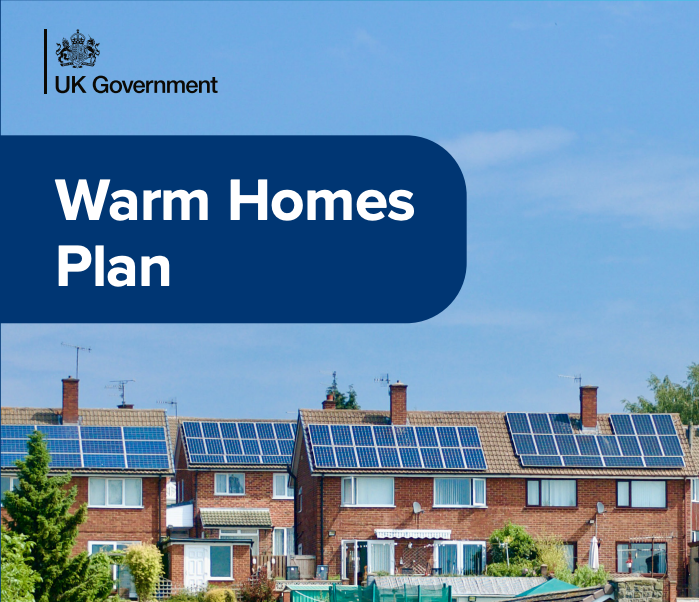
The Government published its Warm Homes Plan back in January this year. As plans begin to emerge for the new Warm Homes Loans Scheme, what will the new support mean for homes in our area?
The Government’s Warm Homes Plan is a £15 billion investment programme aiming to upgrade five million homes across the UK by 2030. The plan has a strong focus on solar PV, batteries and heat pumps. This shift towards electrification marks a change from many previous government home energy policies, which often focused more on insulation.
The plan makes the strong case for action and concludes that solar PV, batteries and heat pumps offer the best potential to reduce household energy bills, whilst supporting the national shift to clean, homegrown power that the UK needs to protect against the volatility of fossil fuel shocks in the longer term.
“Our current dependence on volatile and expensive fossil fuels is bad for energy bills, energy security, fuel poverty and climate change.
The solution is cheap, clean power in the home, through solar panels, battery storage, and clean heat, alongside energy efficiency.
But today too many people are shut out from accessing the benefits of home upgrades and clean energy.”
The plan goes on to set out a broad package of support to help more households access these energy saving technologies.
Let’s take a look at what this new support is likely to mean for homes in our area.
Support for homeowners
Homeowners will have access to two key forms of support:
Capital grants for heat pumps and other forms of clean heating
Low / zero interest rate loans to help cover the up front costs of clean heating plus solar PV and batteries.
Here’s a summary of what we know so far:
Grants
The current Boiler Upgrade Scheme (BUS) is being continued to provide grants for air source heat pumps, air-to-air heat pumps, ground source heat pumps and biomass boilers.
Current grant levels are:
£7,500 towards an air source heat pump (sometimes called an air-to-water heat pump)
£2,500 towards an air-to-air heat pump
£7,500 towards a ground source heat pump (including water source heat pumps and those on shared ground loops)
£5,000 towards a biomass boiler
Until March 2027, you can get an additional £1,500 towards an air source heat pump if your property is heated by oil or LPG and you don’t have a mains gas connection
The Government also plans to introduce grants of £2,500 for heat batteries, although these are not yet available.
Low / zero interest rate loans
New low / zero interest rate loans are also being introduced, through the Warm Homes Loan Scheme, to offer more affordable finance for solar PV, batteries and heat pumps.
The rules for this scheme have recently been announced and this is what we know so far:
The scheme is due to start in September, with lenders being encouraged to apply for participation now.
A range of lenders, including banks and building societies, are expected to take part.
The scheme works by providing government funding to lenders to reduce borrowing costs (the government has earmarked £300 million, which will be offered to lenders as a 20% grant for each loan).
For loans lasting three to ten years, the subsidy is expected to reduce interest rates by around five percentage points compared with standard commercial rates.
You won’t apply to the Government directly. Instead, you’ll apply through a participating lender, much like a standard home improvement loan.
The loans will be available to owner occupiers and private landlords, and there will be no income caps or minimum Energy Performance Certificate (EPC) rating requirements to qualify.
For heat pumps, you can stack the loan with grant funding under the Boiler Upgrade Scheme. For instance, you would claim the £7,500 grant (or £9,000 for oil/LPG homes) toward a heat pump first, and then use a low-interest WHLS loan to finance whatever remaining installation balance is left over.
The scheme doesn't restrict how much you spend in total, but there are caps on the total loan amount that can receive the government interest subsidy (NB this cap is calculated before the addition of the BUS grant, in the case of heat pumps):
Solar PV Systems: Up to £15,000
Battery Storage: Up to £15,000
Air-to-Water Heat Pumps: Up to £20,000
Ground Source Heat Pumps: Up to £35,000.
For households in Bath and North East Somerset, this could make technologies such as heat pumps, solar panels and battery storage more accessible than they have been previously.
If you live in a low income household you may also be eligible for additional capital grants under the Warm Homes Local Grant, see more below.
Support for privately rented homes
For anyone privately renting their home, it may be good news, as landlords will be required to improve properties to an Energy Performance Certificate (EPC) rating band C or above by October 2030.
Landlords will be able to access the same grants and loans as outlined above, to help with the cost of upgrades, and will be able to choose which measures they install to reach the C-rating.
There are some exemptions, including a cost cap if the required spending to reach C-rating would exceed £10,000 (or 10% of property value). But since any measures installed from October 2025 will count towards the cost cap, landlords can start making upgrades immediately.
If you live in a low income household you may also be eligible for grants under the Warm Homes Local Grant, see more below.
Support for low income households
For households struggling with high energy bills, on low incomes, or in areas of high levels of deprivation, the Warm Homes Plan could provide the most significant support of all. The Government has allocated £5 billion to help lower-income and fuel-poor households make improvements that are often out of reach because of the upfront cost.
Eligible households will be able to access fully funded grants for measures such as insulation, solar panels, and heat pumps. The aim is to help people live in warmer, healthier homes, while reducing energy bills and reliance on expensive fossil fuels.
The scheme will build on the current Warm Homes: Local Grant scheme, which is already operating in many areas.
If your household income is below £36,000 (although it may be above this if you live in certain postcode areas and/or receive certain benefits), and your home has an Energy Performance Certificate (EPC) rating of D or below, you may be eligible for a grant.
For more information on current live grants schemes available in Bath and North East Somerset visit B&NES Council’s Energy at Home website.
Local jobs and trades
The government hopes the support available in the Warm Homes Plan will help grow the UK’s home energy sector, creating opportunities for manufacturers, installers and skilled trades. For areas like Bath and North East Somerset, this could mean increased demand for local retrofit and heating specialists.
The ambitious targets include:
450,000 new heat pump installations every year by 2030 (the current level is 84,000 a year)
70% of all new heat pumps installed manufactured in the UK
3 million solar PV systems installed by 2030 (up from around 1.6 million today)
180,000 new jobs created by 2030
BWCE is already seeing increased demand for high-quality heat pump installations and have been working with local trades to help them upskill through our Heat Pump Support project.
What to do next
As we wait for full details of the Warm Homes Loan Scheme to emerge in September, there are plenty of things homeowners can do already:
Plan energy upgrades alongside other renovations - If you’re already thinking about a new kitchen, extension or general refurb, this is a good time to factor in insulation, ventilation or heating upgrades. Doing things in the right order can save time, money and minimise disruption.
Get impartial expert advice - Independent advice can help you understand how your home performs, which upgrades make sense with your budget, and how work could be phased over time. Book a call with us, or with the free Retrofit West advice line, to get started.
Book a discounted survey to get tailored recommendations - A whole-house energy efficiency survey can give you tailored recommendations and help you prioritise the measures that make most sense for you. BWCE offers a range of discounted retrofit plans and Retrofit West also offer a similar service for landlords.
Start speaking to installers and comparing quotes - You can use Retrofit West’s Trusted Trades Directory to get quotes. Comparing options early helps you understand costs and lead times, so you’re not starting from scratch when loans become available.
And if a heat pump is on your radar - the Boiler Upgrade Scheme is already live and offers up to £7,500 off the cost of an eligible installation. Check out the Boiler Upgrade Scheme and our independent Heat Pump Assessment service.
While some details are still to be confirmed, the Warm Homes Plan signals a major shift towards supporting clear heating, solar power and battery storage in homes across the UK. For anyone considering home energy upgrades, now is a good time to start understanding your options and planning ahead.
You can read the full Warm Homes Plan and see the recent presentation slides by our Home Energy Specialist, Cathy Crozier-Cole, for Go Green Widcombe.